Security Training
Security Guard De-Escalation Training: 7 Questions to Ask Your Security Company Before California's 2029 Deadline
Key takeaways
- De-escalation means using communication, positioning, and time to calm a tense person and resolve a situation without force.
- SB 1203 raises California guard skills training from 32 to 42 hours starting January 1, 2029. It must be taught in person, and 8 hours must be role-play de-escalation practice.
- Employers will pay for the training and for guards' training time.
- You don't have to wait until 2029. Ask your security company the 7 questions below today.
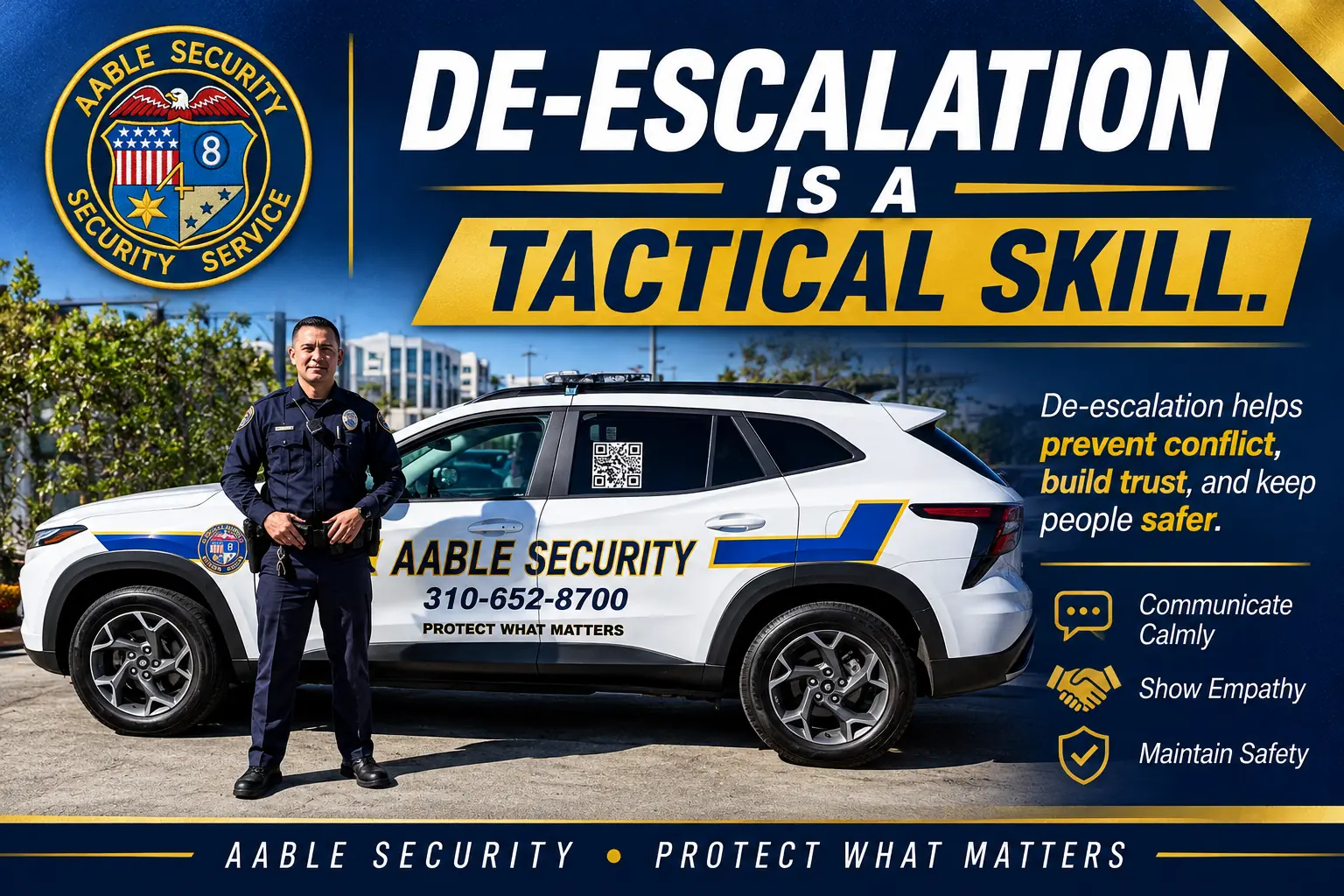
It's 4:45 on a Friday. A tenant who just got a parking citation storms into your lobby, shouting at the front desk. Your receptionist freezes. Other visitors stop and stare, and one of them takes out a phone.
What happens in the next 30 seconds depends on one person: your security officer.
A guard who matches the tenant's anger turns a complaint into a scuffle, an injury claim, and a video your property manager will see on Monday. A guard trained in de-escalation lowers their voice, steps between the tenant and the desk, listens, and walks the tenant to the leasing office. Nobody remembers it by Monday.
That difference is what you're paying for when you hire security. Here's why de-escalation matters, what California's new law requires, and how to tell whether your security company is ready.
What is de-escalation in security?
De-escalation is the use of communication, positioning, and time to calm a tense person and resolve a situation without physical force. For a security officer, it means recognizing rising tension early, staying in control of their own reactions, and giving the other person a safe way to back down. Force stays a last resort, used only when someone's safety requires it.
California's Bureau of Security and Investigative Services (BSIS) already includes de-escalation in the required Power to Arrest training. That curriculum covers using time, distance, cover, and concealment to avoid situations that lead to violence.
Why is de-escalation the most important skill a security guard can have?
Most of a security officer's day isn't spent stopping crimes. It's spent with people: frustrated tenants, intoxicated guests, someone in a mental-health crisis at the door, or a trespasser who doesn't want to leave. How the officer handles those moments shapes your safety, your liability, and your reputation.
Federal data back this up. In nonfatal workplace violence incidents, the offender was unarmed 78% of the time (U.S. Bureau of Justice Statistics, 2015–2019 data). When the other person isn't armed, a trained officer's words, tone, and positioning are often the best tools available.
De-escalation protects your business in four ways:
- People. Employees, tenants, customers, and the officer stay safe when a situation never turns physical.
- Liability. Every use of force creates risk for you and your security provider. Avoiding force avoids that risk.
- Reputation. A calm response doesn't go viral. A shoving match in your lobby can.
- Relationships. Tenants and customers who see conflict handled with respect feel safer, not policed.
The bill's author made the same point when she introduced SB 1203. California guards increasingly encounter people in mental-health or substance-use crises, and those encounters call for a trained, calm response, not a confrontation.
The four pillars of de-escalation
California's BSIS training teaches four core concepts of de-escalation. Here's what each looks like on your property.
1. Self-control
The officer manages their own emotions first. A calm voice, relaxed posture, and steady breathing signal that the situation is under control. An officer who takes insults personally can't de-escalate anyone.
2. Effective communication
The officer listens more than they talk. In practice, that looks like this:
- Use the person's name if they know it, and introduce themselves.
- Acknowledge the feeling: "I can see you're frustrated about this."
- Keep sentences short and simple, and avoid commands like "Calm down."
- Offer choices instead of ultimatums: "We can talk here, or I can walk you to the leasing office."
3. Scene assessment and management
The officer reads the whole situation, not just the person in front of them. They keep a safe distance, note exits, move bystanders away, and decide early whether to call a supervisor or the police.
4. Force options
The officer knows the legal limits of force and treats it as a last resort. Knowing exactly when to step back and call law enforcement is part of the skill.
What does SB 1203 change for California security guards?
SB 1203, the "Stand for Security" Act, was signed by Governor Newsom on September 30, 2026 (Chapter 1016, Statutes of 2026). Starting January 1, 2029, it raises required security guard skills training from 32 to 42 hours, requires in-person classroom instruction, and dedicates 8 hours to hands-on de-escalation practice. Employers must pay for the training and for guards' time.
| Requirement | Today | Starting January 1, 2029 |
|---|---|---|
| Skills training after registration | 32 hours (16 within the first 30 days) | 42 hours (18 within the first 30 days) |
| Training format | Not specified in law | Traditional in-person classroom |
| Hands-on de-escalation practice | Covered in BSIS course topics | 8 hours of in-person role-play, using evidence-based, trauma-informed techniques |
| Training while on duty at a post | Not addressed | Not allowed |
| Who pays for training and training time | Not specified; guards often pay | The employer |
| Annual refresher training | 8 hours | 12 hours, including 4 hours of de-escalation |
Source: SB 1203 bill text, California Legislative Information.
What this means for you: security companies will spend more time and money training officers, and they'll have to schedule it without leaving your post uncovered. The companies that already train this way will adjust easily. The ones that don't will have a harder time.
How de-escalation supports your SB 553 workplace violence prevention plan
Since July 1, 2024, SB 553 has required most California employers to keep a written workplace violence prevention plan. It also requires training employees to recognize, avoid, and de-escalate violent situations. Your security officers are often the first people to respond to an incident, so their training should match your plan.
A strong security partner reads your plan, follows its procedures on site, and writes incident reports that help you keep the violent incident log the law requires. Read our SB 553 compliance guide.
7 questions to ask your security company about de-escalation
Use this checklist when you're hiring a new security provider or reviewing your current one.
1. How many hours of de-escalation training do your officers get, and is it hands-on?
A good answer names specific hours, describes role-play scenarios, and includes yearly refreshers. "It's covered in the guard card course" isn't enough.
2. Are your company and officers licensed by BSIS?
Ask for the company's Private Patrol Operator (PPO) license number and confirm it on the state's online license lookup. Every officer should hold an active BSIS guard card.
3. How are you preparing for SB 1203's 2029 requirements?
Look for a real plan: in-person training, paid training time, and scheduling that won't leave your property uncovered.
4. What is your escalation protocol?
Your provider should explain exactly when an officer steps back, calls a supervisor, or calls 911. Vague answers are a red flag.
5. How do your officers handle someone in a mental-health or substance-use crisis?
A good answer describes specific training and a calm, safe approach, not just "we remove them from the property."
6. How will you report incidents to me?
Ask to see a sample report. You want written details with times, actions taken, and outcomes, delivered promptly.
7. How will your officers support our SB 553 workplace violence prevention plan?
The right partner has read your plan, follows its procedures, and gives you reports you can use for your violent incident log.
How Aable Security trains its officers
Since 1998, Aable Security has protected 500+ commercial properties across Los Angeles. Our officers are trained to resolve situations calmly and treat force as a last resort.
- Every officer holds an active BSIS guard card, which requires the state's Power to Arrest training, including de-escalation and interpersonal communication
- Licensed by BSIS as a Private Patrol Operator (PPO #13693), with $2M in general liability insurance
- Detailed written incident reports for every post
Want to see how our officers would handle situations on your property? We'll walk you through it during a free Security Assessment.
Businesses including Starbucks, Fox Sports, East West Bank, and Holiday Inn Express have trusted Aable Security to protect their people and properties.
Frequently asked questions
See how your security measures up
Not sure whether your current security officers are trained to de-escalate? Book a free Security Assessment and we'll review your property, your risks, and your current coverage. You can also get an estimate in minutes, explore our security guard services, or call (310) 652-8700, Monday to Friday, 10am to 6pm.
Aable Security · 6404 Wilshire Blvd #900, Los Angeles, CA 90048 · Securing LA Since 1998 · PPO #13693
This article is general information, not legal advice. For your specific obligations under SB 553 or SB 1203, consult an attorney.
Want more security insights like this?
PPO #13693 | $2M General Liability Insured | Securing LA Since 1998